

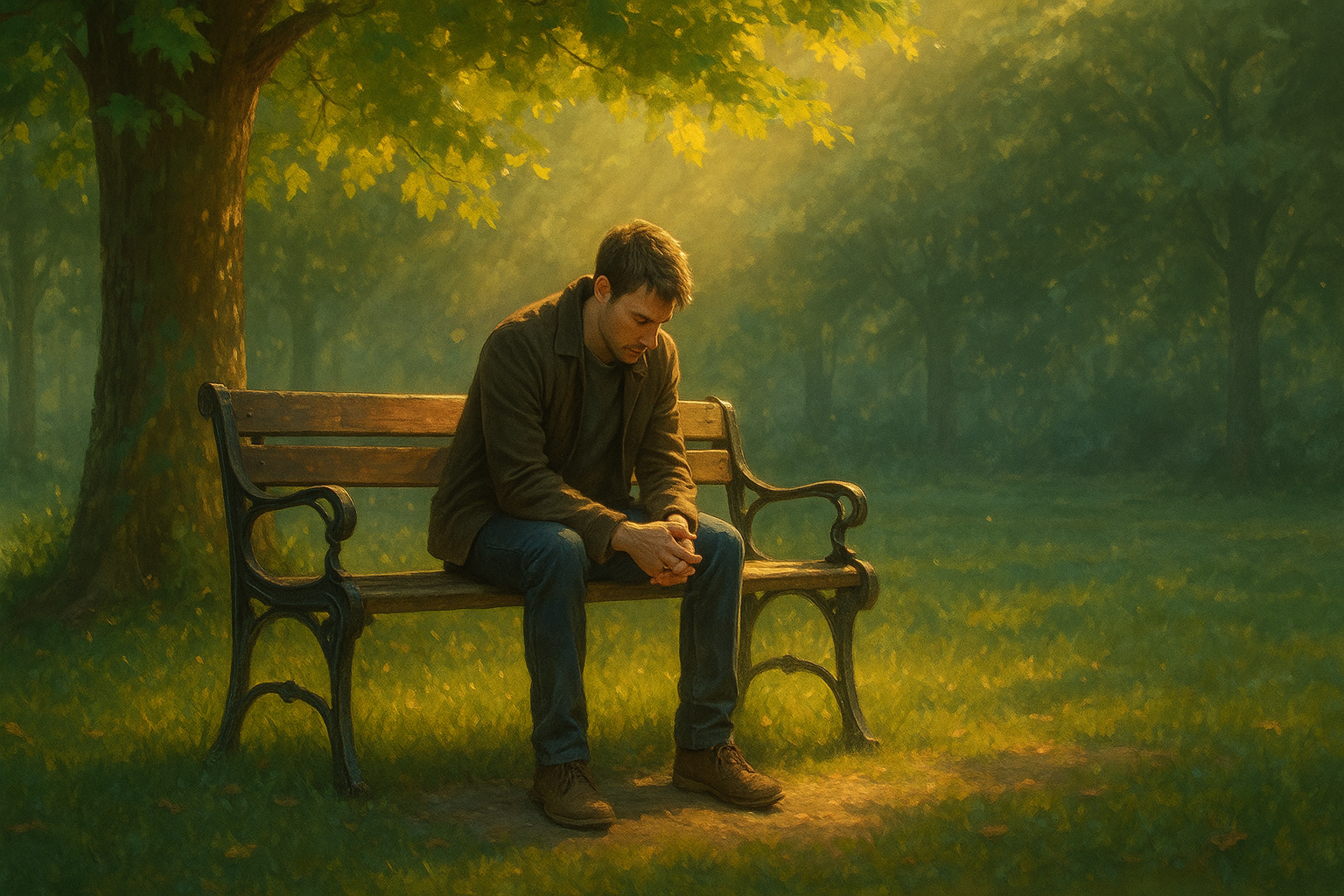
By the time Elias found the bench, he had run out of ways to outrun himself.
It was late afternoon in the kind of small city park you forget exists until you need somewhere to go that isn’t home, or work, or the inside of your own skull. The air smelled like cut grass and fried food from a vendor cart on the corner. Children laughed near the swings. A dog chased a squirrel with wild optimism.
Elias walked the perimeter path, hands buried in his jacket pockets, staring at his shoes.
His therapist had suggested “gentle movement.”
His sister had suggested “getting some sun.”
His reflection in the bathroom mirror had suggested, quite rudely, that he was a coward.
He agreed with all of them and did none of it for weeks.
Today, he had run out of excuses.
So he walked.
He didn’t notice the bench at first.
He’d been to this park plenty of times over the years—the same looping path, the same old oak, the same memorial fountain with water that never quite ran clear. And always, the same three benches: one by the pond, one by the playground, one near the path where joggers tied their shoes.
But as he rounded the curve of the pond, where the gravel swerved toward a cluster of trees, there it was:
A fourth bench.
Sitting alone beneath a huge maple whose branches formed a soft green canopy.
The bench was simple—dark wood, wrought-iron arms, the kind of thing you might see anywhere. Except it wasn’t anywhere. It was here, where he was sure nothing had been before.
He stopped.
Squinted.
“I’m losing it,” he muttered.
A child ran past him to the swings, laughing. A woman in headphones walked by with a stroller and did not glance at the bench.
It wasn’t hidden. It just… wasn’t being noticed.
Except by him.
The air around it felt different somehow. Thick and soft, like the hush inside a church when no one’s talking.
On the backrest, a small brass plaque caught the sun.
He stepped closer, unable not to.
The plaque read:
FOR THOSE WHO CARRY TOO MUCH.
SIT AWHILE.
Elias swallowed.
“It’s a park bench,” he told himself. “You’re being weird.”
But it felt like the bench had heard that, and was amused.
He sat.
The second he leaned back, the sounds of the park dimmed.
Not completely. Just enough.
Children still laughed. Birds still sang. Somewhere, a bus hissed at a stoplight. But all of it moved a little further away, like someone had turned the dial down on the world by one careful notch.
Elias exhaled slowly.
His shoulders, which had been up around his ears for weeks, dropped half an inch.
He stared at the ground between his shoes.
He’d tried not to think about That Night.
The accident.
The screech of tires.
The sickening crunch.
The way time had stretched as he held his phone with shaking hands, dialing three numbers he had never thought to call.
He replayed it constantly, despite himself. Not the whole night. Just one moment.
The moment before.
When his phone had buzzed in his pocket with a text—Running late, almost there—and he’d glanced down for three seconds as he stepped off the curb.
Three seconds.
He’d checked the road. He was almost sure he had.
He was pretty sure he had.
But the car had swerved, braked hard, hit the slick patch of rain at the crosswalk. It had spun. Everything had blurred. There had been shouting. Glass. Sirens.
And Hana—bright, loud, ridiculous Hana, his best friend since childhood—had been lying on the pavement, not moving.
She had survived. Miraculously.
Broken ribs. A concussion. Weeks in the hospital.
The driver had been sober, horrified, insured. The police report had said “freak conditions,” “no fault,” “avoidable only in perfect circumstances.”
Everyone told him it wasn’t his fault.
He didn’t believe them.
He had been there.
He had not prevented it.
Therefore, it was his fault.
Simple math.
The bench seemed to breathe under him.
He realized, dimly, that his hands were shaking.
“Okay,” he whispered. “Okay, that’s enough. Just… breathe.”
His therapist had taught him grounding techniques. Name five things you can see. Four things you can feel. Three things you can hear.
He looked up automatically, prepared to list “trees, pond, jogging guy’s neon shorts.”
And froze.
The park had changed.
Not dramatically. Not like a movie set morphing into a fantasy world.
But the light had shifted. Colors deepened. The green of the leaves looked almost impossibly vivid. Dewdrops sparkled at the edges of the grass despite no recent rain.
And in the middle of the path, a few meters away, sat… another bench.
Or rather, another version of this bench, facing his.
It hadn’t been there a second ago.
On it sat someone.
He blinked.
Stared.
And realized he was looking at himself.
Not a mirror-image. Not exactly.
The man on the opposite bench looked like a slightly older Elias. Not by decades. By… experiences.
His shoulders were looser. His face had more lines, but the kind that came from laughing and crying, not scowling. His eyes were familiar and strange at once—still brown, still his, but steadier.
Bench-Elias gave him a small, knowing smile.
“Hey,” he said. “You made it.”
Elias considered the possibility that he’d fallen asleep on the bench and was dreaming.
He considered it for all of one second.
Then his chest ached and his palms were sweating and everything felt too sharp to be a dream.
“Who are you?” he asked, voice rough.
“You, with fewer sharp edges,” the other replied easily. “You, after you stop trying to punish yourself forever.”
Elias laughed once, a harsh, incredulous sound.
“That’s not going to happen,” he said. “This—” he gestured vaguely at his chest, his head, the invisible weight he’d been carrying— “this is permanent.”
The other Elias tilted his head, studying him.
“Is it?” he asked.
Elias clenched his jaw.
“I screwed up,” he said. “I should have seen the car sooner. I should have grabbed her arm. I should have—”
“You should have had complete control over physics, weather, and the behavior of strangers?” the other asked mildly. “Seems ambitious.”
“I looked at my phone,” Elias snapped. “For three seconds. If I hadn’t—”
“You don’t know that,” the other said.
Elias surged to his feet, then sat back down when the world swayed.
“Everyone keeps saying that,” he bit out. “The driver. The doctors. My sister. ‘You don’t know that. It wasn’t your fault.’ But I was there. I could have done more. I should have done more.”
The other man’s gaze softened.
“You think if you suffer enough,” he said quietly, “it will somehow retroactively protect her. Like grief is a time machine.”
Elias glared at him.
“Don’t psychoanalyze me,” he muttered.
“Bit late,” the other said wryly. “I’m literally your future self on a magic therapy bench, mate.”
Elias blinked.
“I don’t… believe in magic.”
“Funny,” the other said, looking around at the doubled park, the glowing leaves, the impossibly calm air, “because you’re sitting on it.”
They sat in silence for a while.
Birds hopped in a nearby shrub, unconcerned with temporal anomalies.
A child laughed somewhere far away.
Finally, Elias whispered, “She almost died.”
The other’s expression changed.
“Yes,” he said. “She did.”
“And I—”
“You were terrified,” the other said. “You held her hand in the ambulance. You called her family. You sat in an uncomfortable chair in an ER for seven hours. You brought her ridiculous socks with cartoon octopuses.”
“How do you know about the socks?” Elias demanded.
The other smiled a little.
“Because I remember buying them.” He sobered. “I remember all of it. And I remember something else, too.”
“What?”
“The way you’ve turned that night into the only story about yourself that you’ll believe,” he said. “The story where you are The One Who Failed.”
Elias’s throat tightened.
“That’s who I am,” he said.
“That’s what you did,” the other corrected. “Or didn’t do. That’s one moment. A big one. But not the only one.”
He leaned forward, forearms on his knees.
“Tell me something,” he said. “Before the accident, were you a bad friend?”
“No,” Elias said immediately. Then, “I mean. I don’t think so.”
“Did you go out of your way to hurt Hana?”
“Of course not.”
“Have you been there since?” the other pressed. “When she needed rides to physio? When she had panic attacks crossing streets? When she needed someone to sit on the floor with her and eat noodles out of the pot because walking to the table hurt too much?”
Elias’s eyes burned.
“Yes,” he whispered.
“So,” the other said gently, “why do you define yourself solely by the worst thirty seconds of your life, instead of the thousands of hours you’ve spent being kind?”
“Because those thirty seconds almost got her killed.”
“Almost,” the other echoed softly. “Not actually.”
Guilt flared in Elias’s chest.
“You’re saying I should just… be grateful she survived and move on?”
“I’m saying you can be grateful and still sad,” the other replied. “You can wish it never happened and accept that it did. But punishing yourself forever doesn’t honor her pain. It just multiplies it.”
Elias wanted to argue.
He wanted to hold onto his self-loathing like a shield. It felt righteous. Necessary. As if letting it go would be an insult to what they’d all gone through.
“If I forgive myself,” he said hoarsely, “doesn’t that mean I’m saying it was okay?”
“No,” the other said. “It means you’re saying, ‘I am human. I made a mistake, or maybe I didn’t, but either way something terrible happened and I will not spend the rest of my life living in that single frame of film.’”
He looked at Elias with something like tenderness.
“You don’t owe eternal self-hatred to the people you love,” he said. “If anything, they’d like you to stop.”
Elias thought of Hana’s face the last time she’d come over. The way she’d grabbed his wrist when he apologized for the thousandth time, and said, sharply:
“Eli. I need my friend back. Not a walking apology.”
He had nodded. Promised to stop.
Then gone home and replayed the scene in his head until 3 a.m.
“What if I can’t?” he whispered. “What if I don’t know how?”
The other Elias smiled a little.
“That’s why the bench brought you here,” he said.
Elias looked down at the brass plaque:
FOR THOSE WHO CARRY TOO MUCH. SIT AWHILE.
“Is that… what this is?” he asked. “Some kind of… forgiveness bench?”
The other nodded.
“It appears for people who’ve decided that self-forgiveness is for other people,” he said. “But not for them. It gives them a glimpse of who they could be if they put the burden down.”
He gestured to himself.
“Hi. Exhibit A.”
Elias swallowed.
“So you… forgave us?”
“Eventually,” the other said. “Not all at once. Not in some cinematic moment of epiphany. Little by little. Like loosening a knot. Like taking off a heavy backpack one strap at a time.”
“How?”
“Therapy,” he said promptly. “Crying. Talking to Hana and actually believing her when she said she didn’t blame us. Writing down what happened from everyone’s point of view, not just ours. Time.” He paused. “And this bench.”
He glanced up at the maple branches, rustling softly in a wind Elias couldn’t feel.
“The first time, I sat where you’re sitting,” he said. “I shouted at myself over there.” He pointed to his own bench. “I told him he had no idea how heavy it was. He just… listened. Offered me a different story. I didn’t believe him. Not fully.”
“What changed?” Elias asked.
The other’s eyes softened.
“Nothing,” he said. “And everything. I got tired.”
“Tired?” Elias echoed.
“Of being the villain in my own narrative,” the other answered. “Of waking up every day and picking at the scab. Of refusing to let myself enjoy anything because I thought it meant I’d forgotten what happened.”
He leaned in.
“Here’s the thing,” he said quietly. “You don’t forget. Forgiveness isn’t amnesia. It’s acceptance that the past won’t change, but you still can.”
Elias stared at his hands.
They looked the same as always.
They looked like hands that had failed to catch a friend.
They also looked like hands that had held that friend through nightmares, made soup, signed discharge papers, held, soothed, helped.
“I don’t know if I deserve it,” he said.
“I know,” the other replied. “We never think we do.”
He tilted his head.
“Do you think Hana deserves to forgive herself for crossing the street that day?” he asked.
“What? Yes! She didn’t do anything wrong.”
“Do you think the driver deserves to live a life where that night isn’t the only thing that defines him?”
Elias hesitated.
“He was careful,” he admitted. “He… he cried, too. He visited the hospital. He…” He swallowed. “Yes. I hope he forgives himself.”
The other nodded.
“Interesting,” he said gently. “Everyone gets a chance at mercy except you.”
The words landed like a stone in a still pond.
Ripples moved through Elias’s chest.
“You’re allowed to include yourself in the group of humans,” the other said. “Messy, fallible, hearts-too-big-for-their-bodies humans.”
Silence settled between them.
Finally, the other Elias stood.
Time didn’t seem to move with him. The sun stayed at the same angle. The shadows didn’t lengthen.
“I have to go,” he said. “The bench doesn’t let me linger forever. It has other people to ambush with kindness.”
Panic flickered through Elias.
“Wait,” he said. “I’m not… I’m not fixed.”
“Good,” the other replied. “You’re not a machine. You’re a person. This isn’t about being fixed. It’s about beginning.”
He looked at Elias with something like pride.
“Can you do one thing for me?” he asked.
Elias nodded numbly.
“Tomorrow,” the other said, “when Hana texts to ask if you want to get coffee, don’t think of three reasons you shouldn’t. Don’t cancel at the last minute because you ‘don’t deserve her forgiveness.’ Just go. Sit with her. Let her make you laugh. Let yourself enjoy it for one hour without narrating in your head how awful you are.”
“That sounds… hard,” Elias said honestly.
“It will be,” the other agreed. “Do it anyway. That’s how this starts. One small act of not-being-your-own-enemy at a time.”
He smiled.
“I’ll see you,” he said.
Then, as simply as a blink, he was gone.
The second bench vanished with him.
The colors of the park softened back into their usual palette. The sounds swelled to their normal levels. A dog barked. A child argued with a parent about ice cream.
Elias sat alone on the bench.
The brass plaque gleamed in the late-afternoon light.
FOR THOSE WHO CARRY TOO MUCH. SIT AWHILE.
He closed his eyes.
For the first time since the accident, he let himself imagine a version of his life where That Night wasn’t the only chapter.
It felt… dangerous.
It felt… possible.
He thought of Hana’s face lit by café lights, her hands cupped around a mug. He thought of her saying, I need my friend back.
He inhaled.
Exhaled.
“I don’t know how to forgive you,” he whispered—to himself, to the bench, to the aching place in his chest. “But… I’d like to try.”
The bench warmed under him.
Just a little.
Like sunlight through wood.
A breeze rustled the maple leaves overhead, sounding suspiciously like a sigh of relief.
On his way out of the park, he glanced back.
The bench was gone.
Nothing but grass where it had stood.
If he hadn’t still felt the imprint of the wood under his palms, he might have thought he’d imagined it.
The next day, Hana texted.
coffee? i found a place that does ridiculous donuts.
His instinct was immediate.
He almost typed:
Raincheck? Busy. Sorry.
His thumb hovered over the screen.
He remembered the other him. The way he’d said one small act of not-being-your-own-enemy.
He deleted the draft.
Typed:
Yes. When and where?
There was a long pause, then a flurry of excited messages.
When he arrived at the café, Hana was already there.
She was still walking carefully, but more confidently now. A faint scar curved along her cheek. Her smile was the same as it had been when they were kids plotting elaborate pranks.
“Hey,” she said, eyes bright. “You came.”
“Yeah,” he said. “I did.”
They ordered coffee and ridiculous donuts. They talked about non-accident things. Work. Memes. A terrible movie they both loved. She suggested crossing the street to a bookstore afterward, and he didn’t freeze.
At one point, she reached across the table and squeezed his hand.
“You look lighter today,” she said softly.
He thought of the bench.
“I’m… trying something new,” he admitted.
“What?”
“Not fighting with myself all the time,” he said. “It’s a work in progress.”
Her eyes softened.
“I’m glad,” she said. “I want that for you.”
As they left the café, he glanced up.
Across the street, in a small square of a different park, he saw it:
A bench.
Simple. Wooden. Slightly in shadow.
Two teenagers sat on it, shoulders hunched, talking with the urgent intensity of people confessing secrets.
The plaque on their bench caught the light.
He couldn’t read it from this distance.
He didn’t need to.
He smiled, a little.
“Thank you,” he thought, whether to the bench or to whatever sent it, he wasn’t sure.
Then he turned back to Hana.
“Race you to the crosswalk?” she said, grinning.
He laughed.
“You wish.”
They walked.
On the path behind them, the faintest scent of warm wood and sun-dappled leaves lingered for a moment, then faded.
The bench had done its job.
For now.
There would always be people who carried too much,
who believed they had to hurt to prove they cared,
who thought self-forgiveness was something they’d have to earn by being perfect.
For them, sometimes, a bench would appear.
Quietly.
Just when they needed a place to sit down, put the burden beside them,
and imagine—for one brave minute—
what it might feel like
to walk away lighter.